Why processes alone are not enough
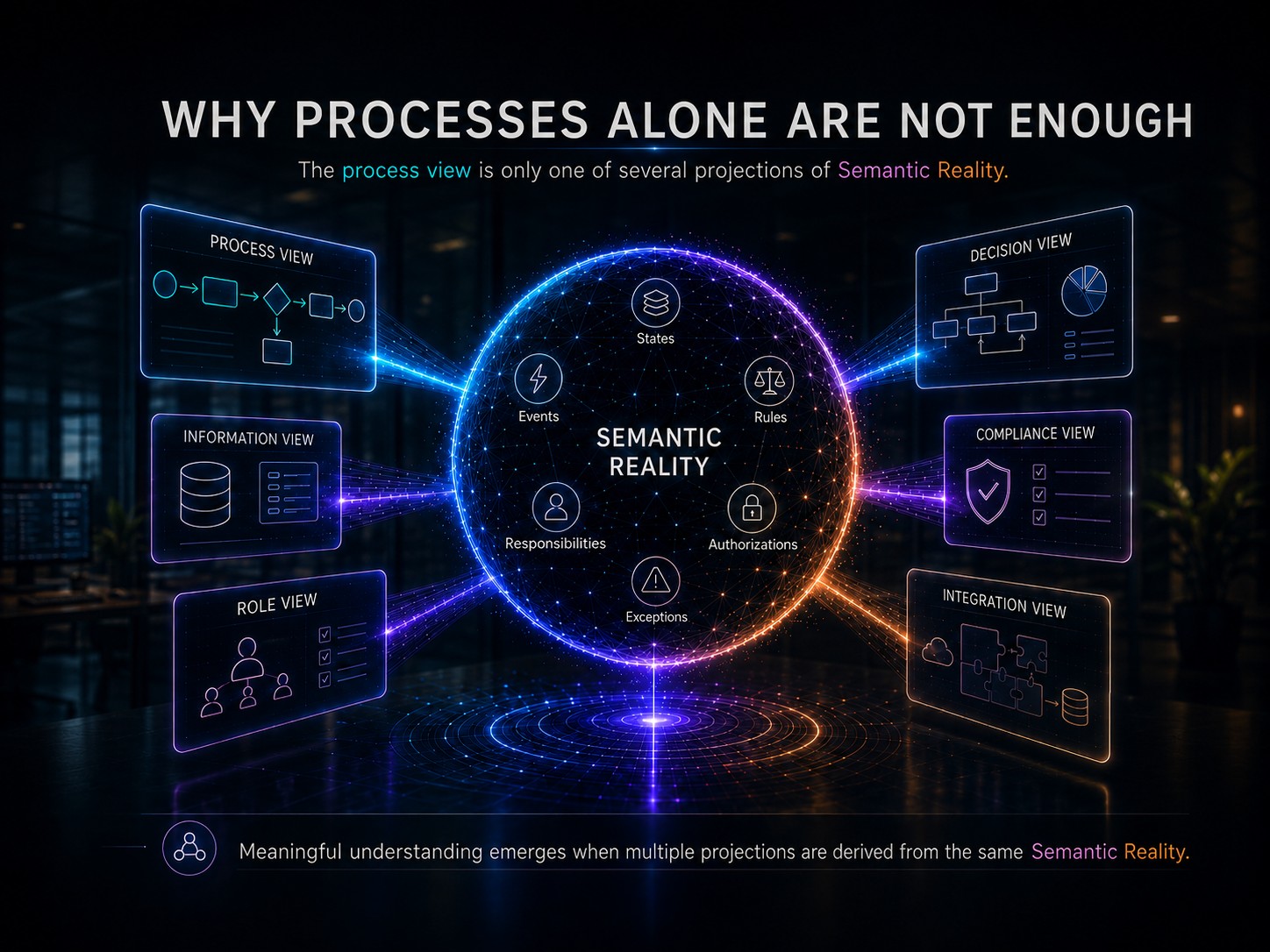
Processes remain important. They show only one view of a much richer business reality.
Processes create orientation
Process models make flows visible, connect organisational units and support standardisation, control and automation. Their value is undisputed.
The problem is not the process idea itself, but that a flow model describes only part of what understanding and implementation require.
What a flow alone does not show
Triggering situations
Events, states and conditions determine when a flow becomes relevant at all.
Decision logic
Rules and criteria define which action is allowed or required.
Information and responsibility
Required data, permissions and accountabilities often live outside the process model.
Exceptions and dependencies
Alternative paths, technical dependencies and interactions are often described in separate artefacts.
Fragmented process knowledge
Necessary knowledge is spread across process models, organisation models, business concepts, data models, policies and application systems. Relationships between these artefacts are often not explicit or machine-readable.
The result is not a continuous model of operational reality, but a set of separate descriptions that must be kept in sync permanently.
Three versions of the same reality
The documented process, the technically implemented process and the process as it is actually lived can drift apart over time.
New requirements, systems or rules are not always reflected in every artefact at once. Trust in the models declines and change becomes more expensive.
Complexity is distributed, not removed
Business logic, data, integration, interfaces, event handling, security and operations still have to come together. If these aspects are treated separately, complexity only moves into more models, tools and handovers.
The next step is therefore to embed processes in a shared semantic foundation.
The process is not the source of the action space
When business situations and possible valid changes are described explicitly, they do not have to be reconstructed from process flow.
A process can represent, standardize or coordinate a typical or prescribed path. Where synchronization, deadlines or dependencies require additional coordination, orchestration can be useful or necessary. It is an additional coordination requirement — not the source of business validity.
The process does not define the possible actions. Semantics defines the space in which processes can emerge.