Cognitive action space of the agent
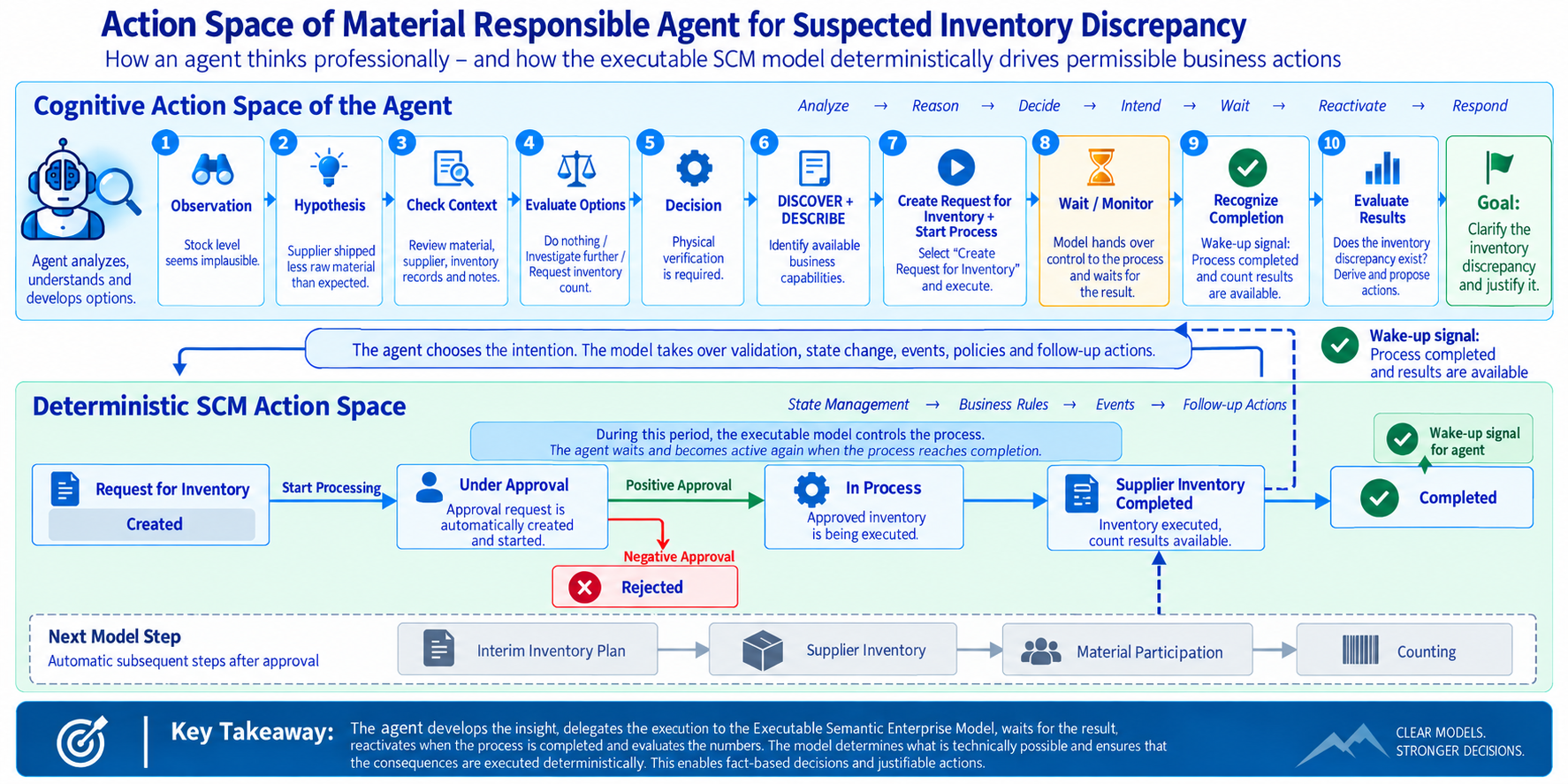
The agent analyses, understands and develops options before committing to an action:
- Observation — the stock level seems implausible.
- Hypothesis — the supplier likely shipped less raw material than expected.
- Check context — material, supplier, inventory records and notes are reviewed.
- Evaluate options — do nothing, investigate further, or request an inventory count.
- Decision — physical verification is required.
- Discover + describe — the available, permissible action and the inputs it needs are identified.
- Create request for inventory + start processing — supplier, due date and reason are set, and the process is started.
- Wait / monitor — the model takes over execution while the agent waits for the result.
- Recognise completion — a wake-up signal indicates the process has completed and count results are available.
- Evaluate results — the agent determines whether the suspected discrepancy is confirmed and proposes next actions.
Click to enlarge
Deterministic SCM action space
Once the agent chooses its intention, the executable model takes over validation, state change, events, business rules and follow-up actions. The request for inventory is created and an approval request is generated and started automatically. On positive approval the case moves to In Process; on negative approval it moves to Rejected. Once the supplier inventory has been executed and count results are available, the model reports Completed and reactivates the agent through a wake-up signal. In the background, the model automatically continues with the business follow-up of Interim Inventory Plan, Supplier Inventory, Material Participation and Counting — without the agent having to trigger each step individually.
Takeaway
The agent develops the insight, delegates execution to the Executable Semantic Enterprise Model, waits for the result, is automatically reactivated once the process is completed and results are available, and draws business conclusions from them. The model determines what is technically permissible and ensures that the consequences are executed deterministically — enabling fact-based decisions and justifiable actions.